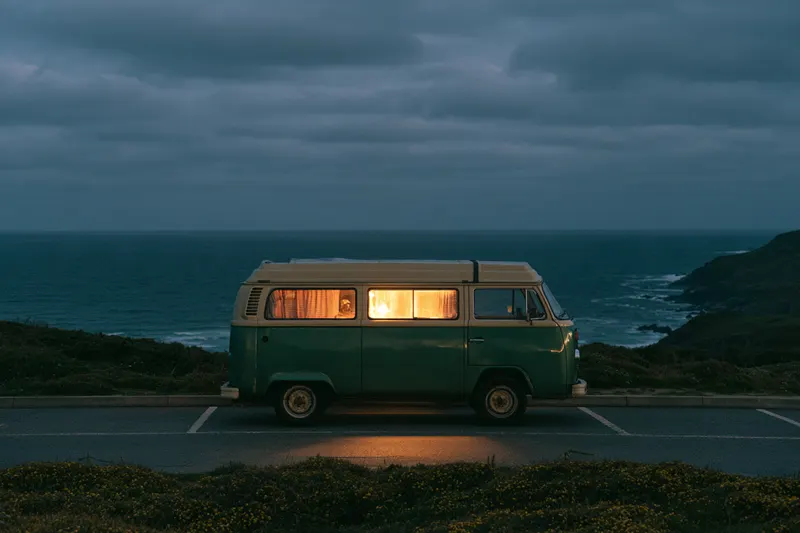
In the UK you can legally sleep in a parked campervan on most public roads and car parks, but you cannot set up camp: no awning, chairs or tables outside. Wild camping in a vehicle is illegal in England and Wales without the landowner's permission, and Scotland's right to roam does not cover motor vehicles.
Where can you park a campervan overnight for free in the UK?
Any public road bay or car park where signage allows, provided you cause no obstruction and your van has a valid MOT and tax. The boundary is visible kit: a closed van with blinds down is parked, while a van with an awning, table and chairs is camping, which most public spaces restrict. This is one of the first things to understand before planning a trip, alongside the real cost of running a converted van.
Parking legally overnight
- Check signage for a Traffic Regulation Order or PSPO
- Keep everything inside the van, engine off
- Use a public car park or road bay that allows it
- Arrive late, leave early, leave no trace
- Have a valid MOT and tax, park without obstruction
Is wild camping in a campervan legal in Scotland?
No, not in a vehicle. The Land Reform (Scotland) Act 2003 gives people the right to camp on foot, including in tents, but motor vehicles have no automatic right to stay overnight on public or private land. You still need the landowner's permission, or a designated pitch, aire or site.
How do councils and national parks restrict overnight parking?
Through Traffic Regulation Orders and Public Space Protection Orders that appear as signs at the entrance to car parks, lay-bys and coastal routes. National parks, AONBs, Forestry England land and several popular coastline council areas ban overnight stays in vehicles, especially in summer. Refusing to leave after being moved on can become a criminal offence with fines around £2,500, so checking signage is not optional. A warm, dry van makes a roadside stop far more comfortable, which is where good insulation and ventilation earn their keep.
Night-by-night plan
- Check rulesLook for signs and check council websites for PSPOs before you settle.
- Choose a spotPrefer motorhome service aires, Brit Stops or CL/CS pitches where you are guaranteed welcome.
- Park tightStay level, quiet and fully inside the vehicle, engine off.
- Move earlyLeave in the morning without a trace.
Where are you guaranteed a legal overnight stay?
Motorhome service aires, Brit Stops and Caravan and Motorhome Club CL and CS pitches, plus campsites open out of season. A typical aire costs £5–£15 a night with water and waste disposal, which buys certainty after a day of reading signs, especially along the NC500 where 2026 restrictions tightened.
Questions we get asked
Is wild camping legal in a campervan in Scotland?
No. The Land Reform (Scotland) Act 2003 allows access on foot, including tent camping, but motor vehicles have no automatic right to stay overnight on public or private land.
Can I sleep in a lay-by?
Usually yes, as parking — provided there is no sign banning overnight stops and you cause no obstruction. Lay-bys in tourist hotspots and National Park zones increasingly carry TRO restrictions, so check the signs.
Do national parks allow overnight van parking?
Dartmoor and parts of the Lake District allow some wild camping for tents; vehicles are more restricted. Forestry England land and many AONB car parks ban overnight stays. A designated pitch is the safe choice.
What happens if I camp where I am not allowed?
You may be moved on as a trespasser. Refusing to leave or returning afterwards can become a criminal offence with fines around £2,500 and, in extreme cases, imprisonment.
What is the difference between parking and camping?
Parking = staying inside the vehicle with no kit outside. Camping = awning, chairs, tables, stoves or ramps set up outside. The distinction decides whether you need permission or a paid pitch.
What kit turns parking into camping?
An awning, camping chairs, a table, an outdoor stove, levelling ramps or ropes and pegs. Leave any of those visible and a parked van reads as a camp. Keep them inside, stay quiet and move on early, and most roadside stops pass without a second look; the enforcement risk climbs as soon as exterior kit appears.
What is the difference between parking and camping?
Parking means staying inside the vehicle with no kit outside. Camping means an awning, chairs, tables, stoves or levelling ramps set up around the van. The distinction decides whether you need permission or a paid pitch, and it is what enforcement officers check first.
Park legally with everything inside the van and you are usually fine. The moment you put kit outside, you cross into camping, which needs permission or a paid pitch.
References
- Alan Boswell Group: parking laws for motorhome and campervan owners — Parking vs camping definitions, Traffic Regulation Orders, roadside and car park rules.
- Ripe Insurance: can you park a campervan anywhere? — Roadside parking legality, trespass, Scotland's access rights and the no-motor rule.
- Birmingham Mail: £2,500 fines for staying overnight in vehicles — PSPOs and byelaws banning overnight stays, refused-to-leave escalation.